
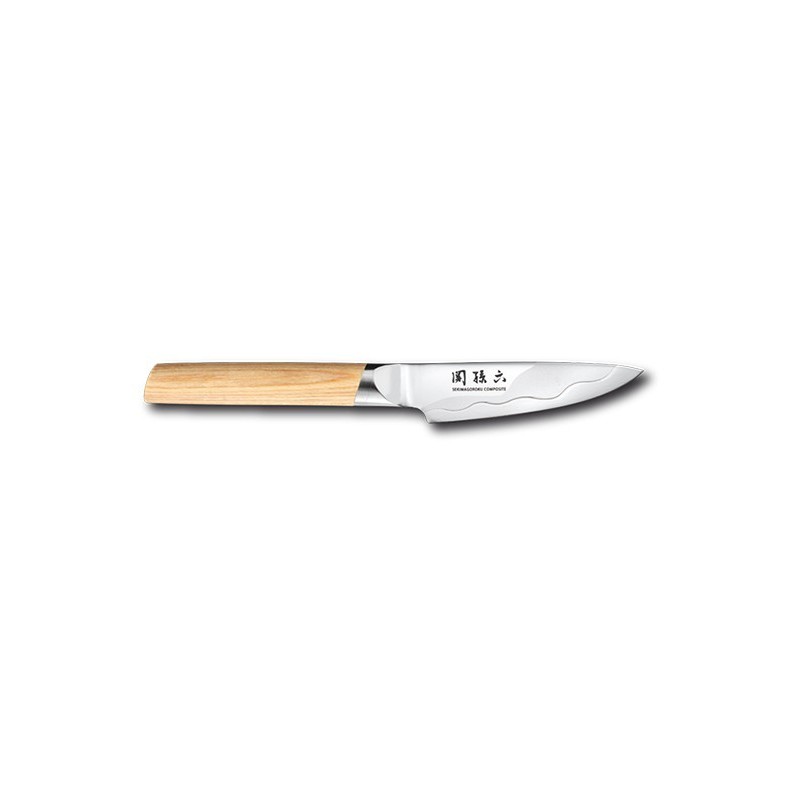

Kai MGC-0400 Seki Magoroku Composite Paring Knife 9 cm
MGC-0400
New
The KAI MGC-0400 Seki Magoroku Composite is an elegant 9 cm Japanese paring knife, designed for precise peeling, trimming and cutting of small fruits and vegetables. Its double-bevel blade combines a VG-MAX steel core with an outer layer of SUS420J2 stainless steel, creating a durable and distinctive construction. With a hardness of approximately 61 HRC, the blade provides precise cutting performance and excellent edge retention. The handle is made from Pakka wood, offering a comfortable grip and lightweight control during food preparation. Made in Japan, the KAI MGC-0400 combines traditional Japanese knife craftsmanship, advanced technology and contemporary design in a practical Japanese paring knife for everyday kitchen use.
By buying this product you can collect up to 18 loyalty points. Your cart will total 18 points that can be converted into a voucher of 8,10 €.
More info
KAI MGC-0400 Seki Magoroku Composite – 9 cm Japanese Paring Knife
The KAI MGC-0400 Seki Magoroku Composite is an elegant 9 cm Japanese paring knife, designed for precision peeling, trimming and cutting of small fruits and vegetables. Its compact size makes it particularly useful for detailed kitchen tasks where control, manoeuvrability and a precise cutting edge are essential.
Part of the Seki Magoroku Composite series by KAI, this Japanese kitchen knife combines traditional Japanese knife craftsmanship with modern blade construction and contemporary design. The series is characterised by its combination of different steels and the distinctive copper line visible along the blade.
The KAI MGC-0400 is therefore an excellent choice for cooks looking for a compact Japanese paring knife that combines precision, lightweight handling and Japanese manufacturing quality.
A Japanese blade designed for precision
The 9 cm blade of the KAI MGC-0400 is specifically designed for detailed preparation work. Compared with a larger chef's knife, a Japanese paring knife provides greater control when working with small ingredients or performing delicate cuts.
Its double-bevel edge makes the knife suitable for both right- and left-handed users, making it a versatile tool for everyday kitchen preparation.
The KAI MGC-0400 is particularly suitable for:
Peeling small fruits and vegetables.
Removing skins and small imperfections.
Cutting garlic, shallots and other small ingredients.
Trimming and preparing fruit and vegetables.
Creating decorative cuts.
Performing detailed food preparation.
Working with small ingredients where a larger kitchen knife may be less practical.
Composite blade construction
One of the defining features of the KAI MGC-0400 is its Composite blade construction. Rather than manufacturing the entire blade from a single steel, KAI combines different steels to take advantage of their individual properties.
The official KAI Europe documentation identifies the Seki Magoroku Composite construction as SUS420J2 / VG10, with VG10 used in the cutting area and SUS420J2 forming the outer section of the blade.
This construction creates a distinctive visual transition between the different steels. The materials are joined using copper, producing the characteristic copper line that runs along the blade and gives the Seki Magoroku Composite series its recognisable appearance.
Advantages of VG10 steel
The VG10 steel used in the cutting area is particularly well suited to a Japanese knife designed for precision cutting. It allows the blade to achieve a fine, sharp edge while offering good edge retention and corrosion resistance.
The main advantages of VG10 steel in a Japanese paring knife include:
Excellent cutting performance: ideal for precise cuts in fruit and vegetables.
Good edge retention: helps maintain cutting performance during regular kitchen use.
Corrosion resistance: suitable for everyday food preparation when properly maintained.
Precision: the combination of steel hardness and blade geometry allows controlled, detailed cutting.
Durability: the Composite construction combines different materials to create a robust and functional blade.
Easy maintenance: with proper cleaning, drying and sharpening, the blade can maintain its performance over time.
The Seki Magoroku Composite series has a hardness specification of approximately 56/61 (±1) HRC, depending on the section of the blade.
KAI Composite technology
The Composite technology is one of the main features distinguishing the KAI MGC-0400 from conventional paring knives.
KAI combines different blade materials and joins them using copper. This manufacturing approach creates a visible transition between the steels and the distinctive copper line along the blade.
Beyond its distinctive appearance, the Composite construction allows different steels to be positioned according to their intended function. SUS420J2 forms the outer section of the blade, while the harder VG10 steel is used in the cutting area.
The result is a lightweight and highly manoeuvrable Japanese kitchen knife designed for precise preparation work.
Pakka wood handle
The KAI MGC-0400 features a Pakka wood handle designed to provide a comfortable and controlled grip.
Its symmetrical construction makes the knife suitable for both right- and left-handed users. The compact handle complements the 9 cm blade and makes the knife particularly easy to control during delicate preparation tasks.
This is especially useful when peeling fruit, trimming vegetables or making small and precise cuts where fingertip control is important.
What is the KAI MGC-0400 used for?
The KAI MGC-0400 9 cm Japanese paring knife is primarily designed for small ingredients and precision preparation. Its compact blade provides excellent control without the additional length or weight of a larger kitchen knife.
It is particularly suitable for:
Fruit: apples, pears, kiwis, strawberries and other small fruits.
Vegetables: carrots, potatoes, courgettes, tomatoes and other vegetables requiring peeling or precise trimming.
Food preparation: cleaning, trimming, removing unwanted sections, decorative cutting and preparing ingredients for more elaborate dishes.
The MGC-0400 is not intended to replace a chef's knife, Santoku or Nakiri. Instead, it complements larger Japanese kitchen knives by providing a specialised tool for tasks where precision and manoeuvrability are the priority.
Main features
Brand: KAI
Series: Seki Magoroku Composite
Reference: MGC-0400
Type: Japanese paring knife / utility knife
Blade length: 9 cm
Construction: Composite
Outer steel: SUS420J2
Cutting steel: VG10
Hardness: 56/61 (±1) HRC
Edge: Double bevel
Handle: Pakka wood
Suitable for: Right- and left-handed users
Made in: Japan
Frequently Asked Questions about the KAI MGC-0400
What type of knife is the KAI MGC-0400?
The KAI MGC-0400 is a 9 cm Japanese paring knife, designed for peeling, trimming, cutting and preparing small fruits and vegetables with precision.
What steel does the KAI MGC-0400 use?
The Seki Magoroku Composite series uses a SUS420J2 / VG10 Composite construction, with VG10 in the cutting area and SUS420J2 in the outer section of the blade.
What are the advantages of VG10 steel?
VG10 steel is widely appreciated in Japanese kitchen knives for its ability to produce a fine and precise cutting edge, good edge retention and good corrosion resistance. These characteristics make it particularly suitable for a precision Japanese paring knife.
What does Composite construction mean?
Composite construction means that the blade is manufactured using different types of steel joined together. In the Seki Magoroku Composite series, the steels are joined using copper, creating the distinctive visible copper line along the blade.
How hard is the KAI MGC-0400 blade?
The Seki Magoroku Composite series has a hardness specification of approximately 56/61 (±1) HRC, depending on the section of the blade.
Is the KAI MGC-0400 suitable for left-handed users?
Yes. Its double-bevel edge and symmetrical handle design make it suitable for both right- and left-handed users.
What foods can I cut with this Japanese paring knife?
The MGC-0400 is ideal for small fruits and vegetables, including apples, pears, strawberries, carrots, tomatoes and similar ingredients. It is also useful for trimming, peeling and detailed preparation.
Can it replace a chef's knife?
No. The two knives serve different purposes. The KAI MGC-0400 Japanese paring knife is designed for precision work with small ingredients, while a chef's knife is better suited to larger ingredients and general-purpose cutting.
Can I use it for hard foods?
The knife is suitable for normal fruit and vegetable preparation, but its compact 9 cm blade is not designed for heavy-duty cutting. It should not be used on bones, frozen food or other materials that could damage the fine cutting edge.
How should I maintain the KAI MGC-0400?
For best results, wash the knife by hand with mild detergent, rinse it thoroughly and dry it immediately. Store it safely so that the blade does not come into contact with other metal utensils. Regular maintenance and appropriate sharpening will help preserve its cutting performance.
Is the KAI MGC-0400 dishwasher safe?
Hand washing is recommended. It helps protect both the fine cutting edge and the Pakka wood handle, extending the useful life of the knife.
Where is the KAI MGC-0400 made?
The KAI Seki Magoroku Composite MGC-0400 is made in Japan, reflecting KAI's tradition of Japanese knife manufacturing and craftsmanship.
Why choose a 9 cm Japanese paring knife?
The main advantage is control. A short, precise blade allows you to work close to the ingredient and perform small movements accurately. For peeling fruit, trimming vegetables and detailed preparation, a 9 cm Japanese paring knife is particularly practical.
Accessories
5 other products in the same category:
Kai MGC-0401 Seki Magoroku Composite...
199,00 €
Kai MGC-0406 Seki Magoroku Composite...
255,00 €
Kai MGC-0402 Seki Magoroku Composite...
255,00 €
Kai MGC-0428 Seki Magoroku Composite...
255,00 €
Kai MGC-0405 Seki Magoroku Bread...
265,00 €